
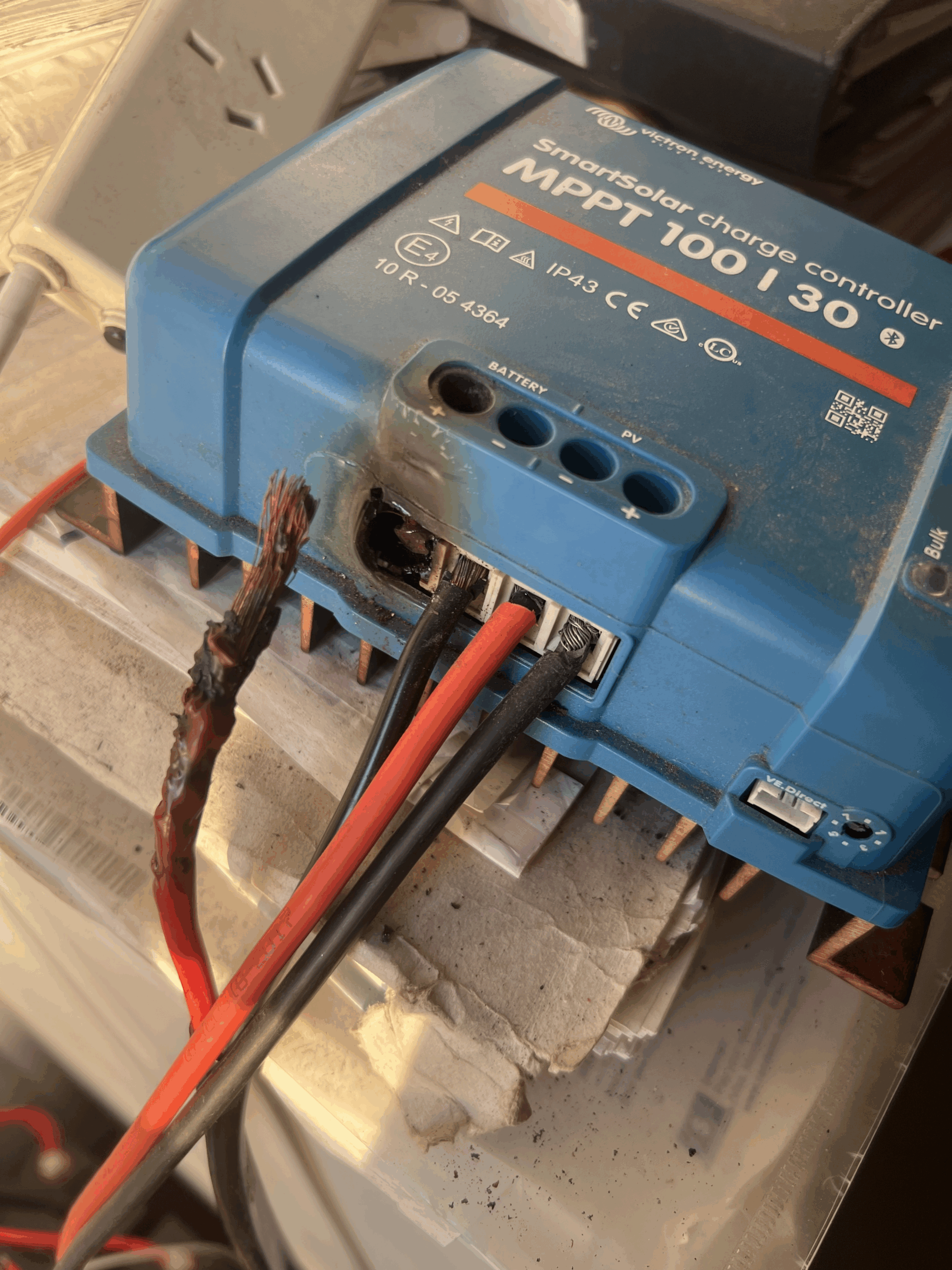
Every solar and battery design that lands on my desk for review has already been signed off by someone. It still has mistakes in it. This is not because anyone was careless, but because a handful of failure points never show up on a visual check. They show up in the field, or in a client’s expectations six months in. These site issues are normally caused by the following design mistakes.
These are the seven I keep finding in real commercial and industrial (C&I) solar and battery storage design mistakes, pulled straight from actual submissions this month. Some of these will be familiar if you’re an installer moving into C&I work for the first time. Others catch experienced designers too, because they sit at the boundary between two components’ spec sheets rather than inside either one.
1. Choosing the inverter on price alone
Two inverters can sit side by side on a quote at wildly different prices and look almost identical on paper. The difference is rarely in the headline spec, it’s in what happens after installation. One has a proper warranty and ongoing firmware and documentation support; the other doesn’t. One can take a battery retrofit later without a redesign; the other locks you out. One has the monitoring and grid support features a C&I site actually needs, the other is missing all of it.
The cheapest number on the page is often the most expensive decision six months later. That said, price comparisons still matter, but only once you’ve confirmed the two products are actually comparable.
2. DC voltage drop never gets calculated
This is the single most common gap I see. Cable size gets eyeballed, or copied from a previous job with a different run length and current. Undersized DC cable loses real power to heat and on a longer run, that’s the difference between a system that performs on paper and one that actually does.
On one real 180 metre run at 25A, a copied over 6mm² cable produced a 4.4% voltage drop, well past the roughly 3% most electrical codes treat as the practical ceiling per run. The correctly sized 10mm² cable for the same run dropped just 1.8%. That gap isn’t cosmetic, it’s continuous power converted to heat, for the life of the system.
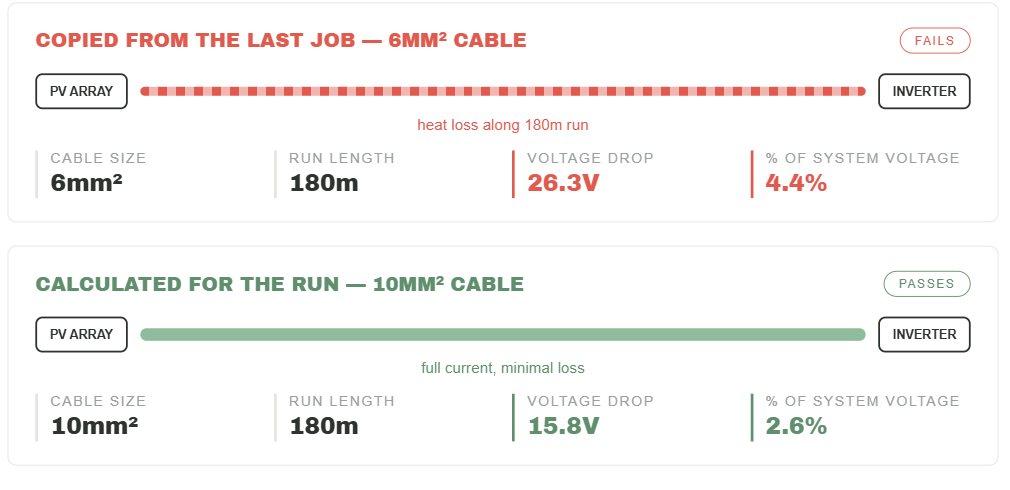
Beyond the lost production, sustained resistive heating accelerates insulation aging and is a genuine fire risk factor, not a theoretical one. And a system quietly losing 4%+ to cable resistance looks like it’s underperforming its panels or inverter. The real fault gets misdiagnosed as a hardware issue when it was buried in an unchecked cable spec.
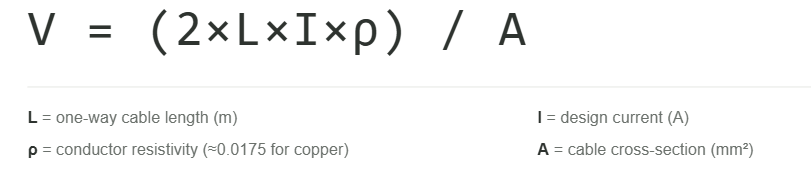
The formula itself isn’t complicated, the mistake is skipping it, not the maths:
3. No protection coordination between PV, battery, and grid-tie breakers
Sizing each breaker in a hybrid system against its own load is easy. Engineers or designers rarely check how breakers behave together when a fault actually happens: which one should trip first, and whether the others back it up rather than compete with it.
Skip that check and you invite one of two outcomes: nuisance tripping that frustrates the client for years, or worse, a fault that doesn’t clear safely because you sized every breaker in isolation.
4. Strings mismatched on the same MPPT input
Wire two strings with different orientation, tilt, or shading exposure into one shared MPPT input, and the electronics track to whichever string is weaker. The stronger string’s extra output doesn’t get lost dramatically — it just quietly disappears, every day, for the life of the system.
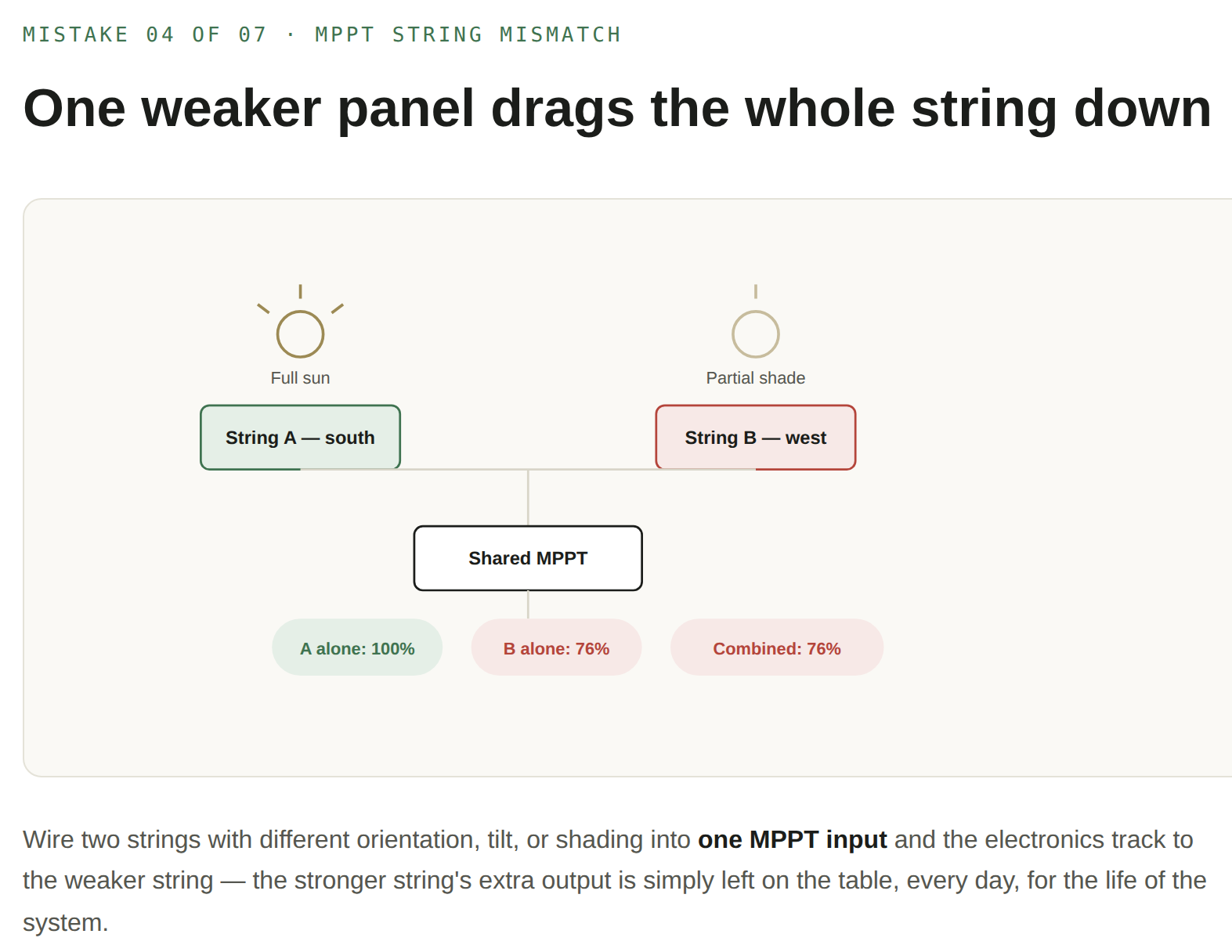
It’s an easy mistake to make on a site with any roof complexity at all, and it rarely shows up unless someone is specifically checking string level production against design expectations.
5. String length sized without checking either temperature extreme
Panel voltage isn’t fixed, it moves with temperature, in both directions, and a string sized only against standard test conditions (25°C) can fail at either end of a real site’s actual weather.
Cold weather pushes voltage up. Add too many panels in series and the string’s open circuit voltage creeps toward the inverter’s maximum DC input rating. In cold weather, that voltage climbs further sometimes enough to trip the inverter’s overvoltage protection and shut the whole string down.
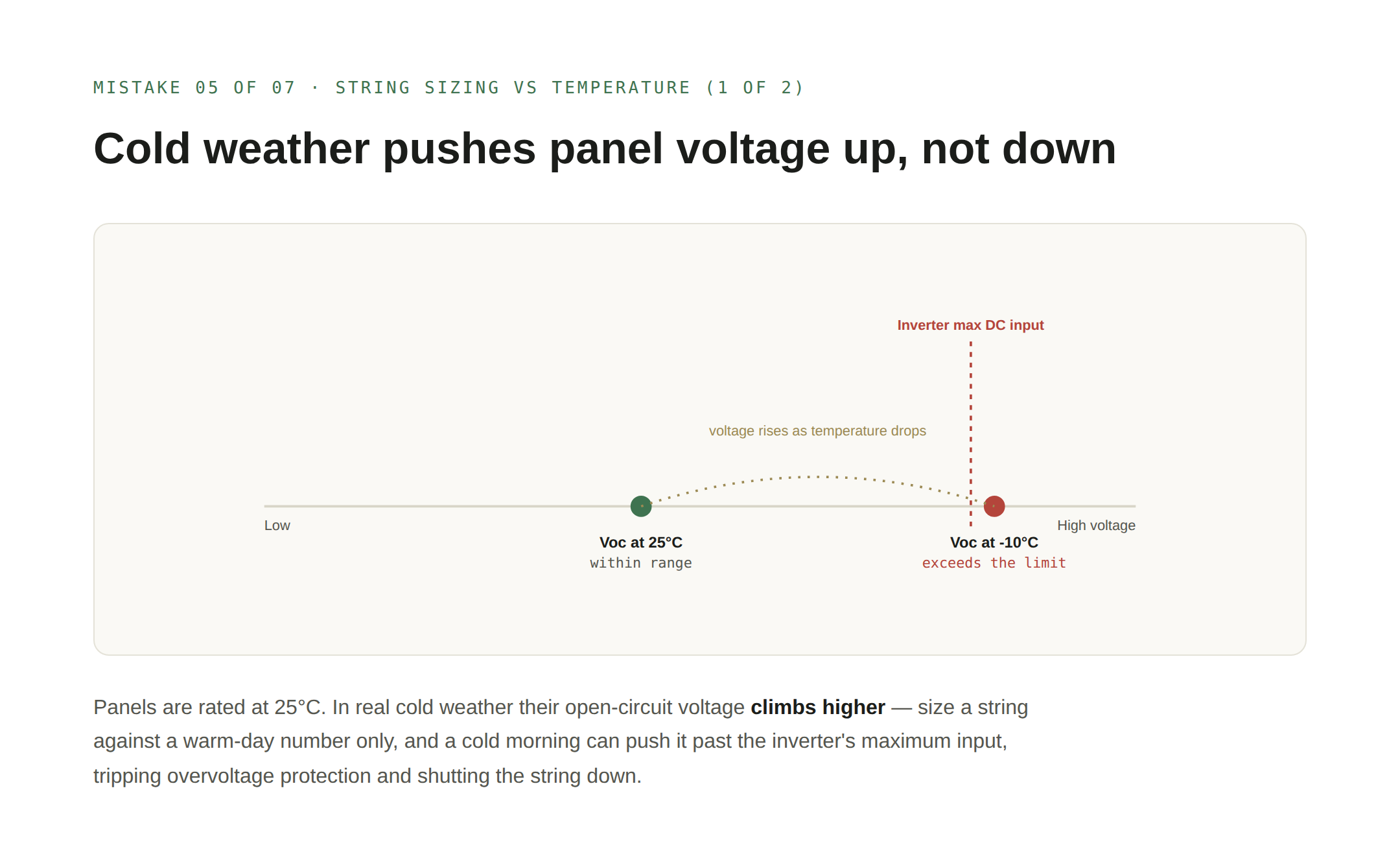
Heat does the opposite. The same string that overvolts on a cold morning can sag and underperform in real heat, dropping output below what the spec sheet promises.
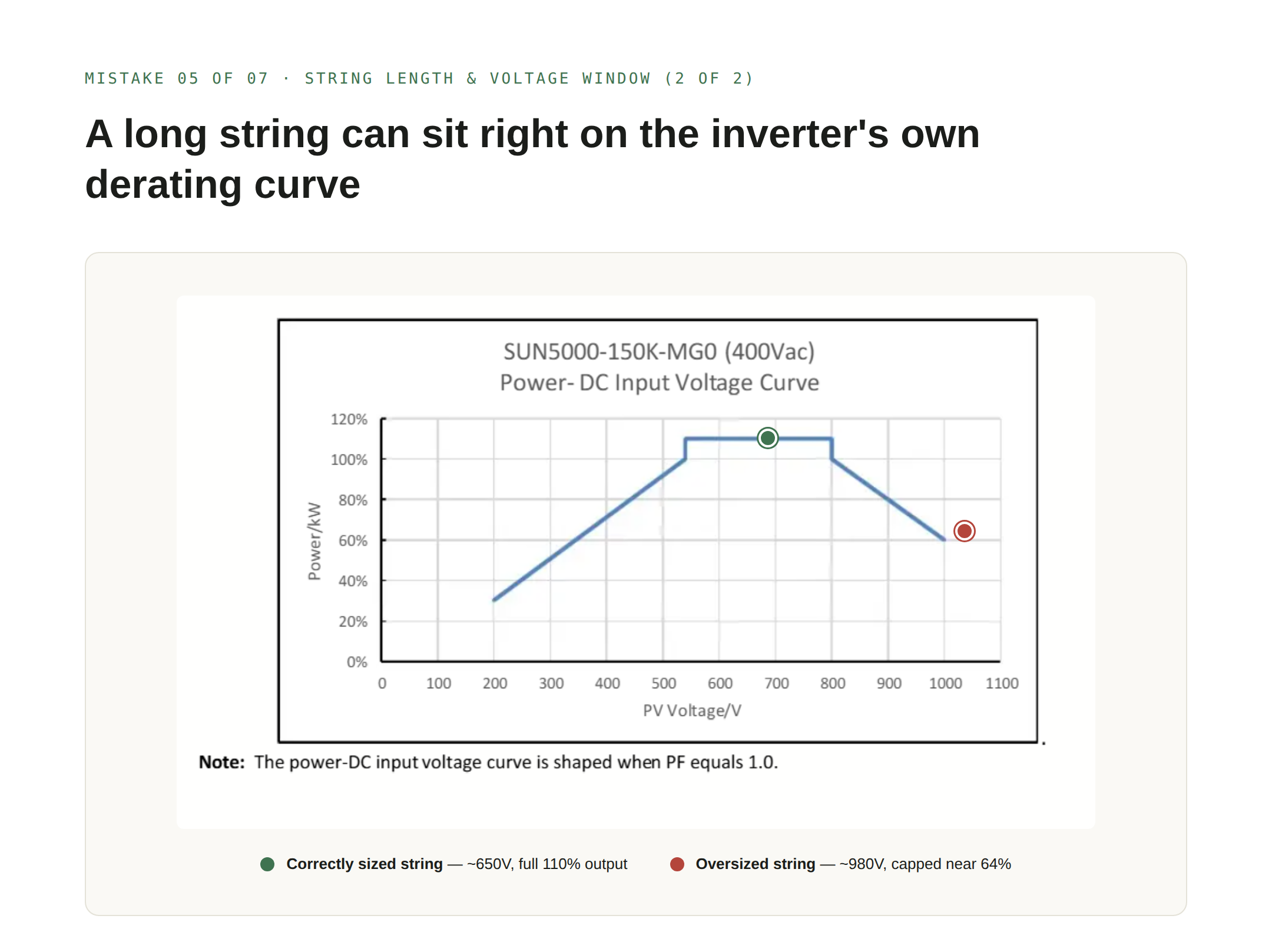
This is where real manufacturer data is worth more than a generic illustration. On a Huawei SUN5000-150K-MG0’s own power-vs-voltage curve, a correctly sized string sitting around 650V holds the full 110% output plateau. While an oversized string pushed toward 980V is capped at roughly 64%, on the manufacturer’s own numbers, with zero shading and perfect weather.
6. Panels pushing more current than the inverter was built for
Voltage compatibility between panels and inverter gets checked almost by habit. Current compatibility doesn’t and it’s just as capable of causing a problem.
Newer high output bifacial panels push more current per string than older generation inverter MPPTs were rated to handle. I’ve seen strings feeding an MPPT rated for a 13A maximum wired with panels capable of well over that.
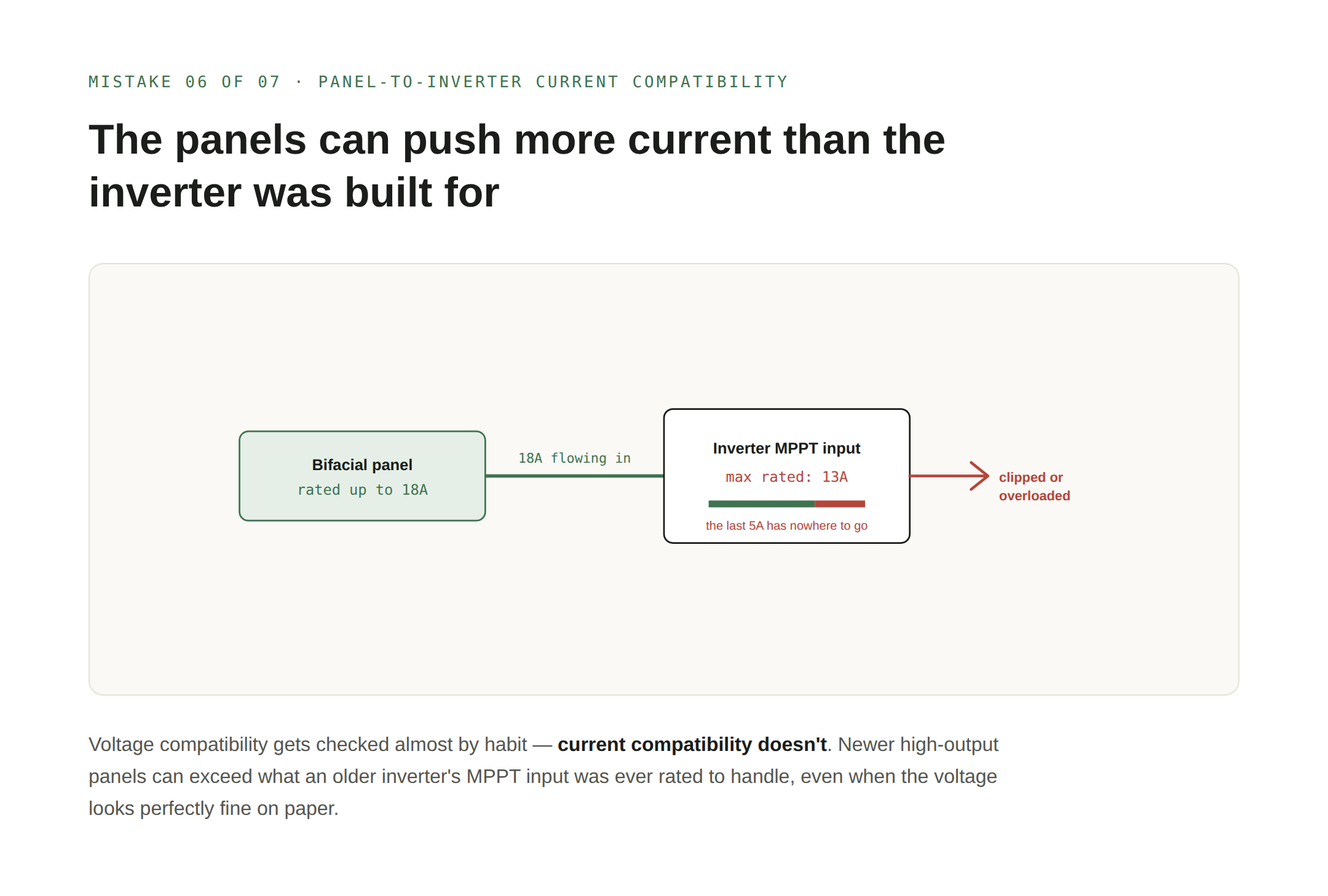
Best case, the inverter simply clips the output and production is lost. Worst case, it’s operating outside its rated limits, the inverter kicks in its protection parameters and goes into standby.
7. Inverter and battery compatibility gets assumed, not confirmed
Two genuinely good products don’t automatically work well together. Any one of these can wreck a hybrid system: a communication protocol mismatch, an uncertified BMS integration between the two brands, or a battery voltage window the inverter was never designed for.
Any one of these can turn two solid components into an unreliable system.
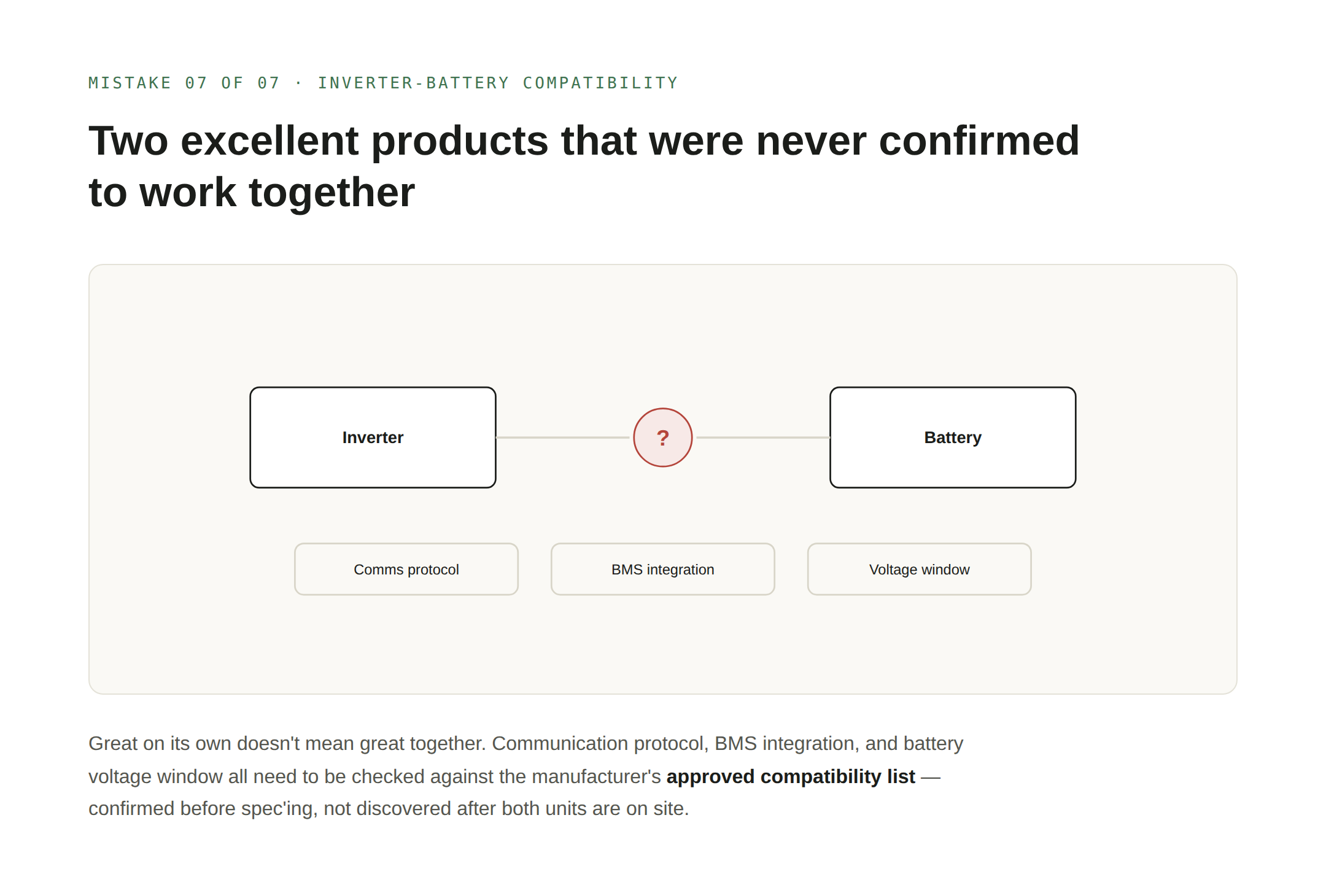
The fix is straightforward: check the manufacturer’s approved compatibility list before specifying the two together, not after both units are already on site.
The pattern across all seven
None of these seven mistakes are exotic. They’re the kind of thing that passes a visual inspection cleanly and only shows up once a system is running. For example, in a warranty claim, a nuisance trip, an underperforming string, or a client asking why the numbers don’t match the proposal.
That’s really what a design review is for: catching the failure points that sit between two components’ spec sheets, rather than inside either one.
This is the first entry in an ongoing weekly series pulled from real design review submissions. If you’re submitting a design for review or just want a second set of eyes before it goes out for quoting, get in touch about a design review or watch the full video breakdown below.
Watch the video: 7 Solar + Battery Design Mistakes I Keep Seeing
Which mistake do you see most often? Let me know in the comments — it might be next week’s episode.

Related Posts

What Is The Difference Between Grid Following Vs Grid Forming

Grid tied Solar System Explained: What SA Homeowners Need to know
