
After integrating battery systems into over hundreds of projects, the question that separates a resilient microgrid from an expensive paperweight is simple, which device is forming the grid, and which ones are just following it? Understanding the difference between grid following and grid forming inverters changes how you specify equipment, configure controllers, and guarantee black start capability when the utility fails.

Grid Following Inverters: Synchronizing to an Existing Reference
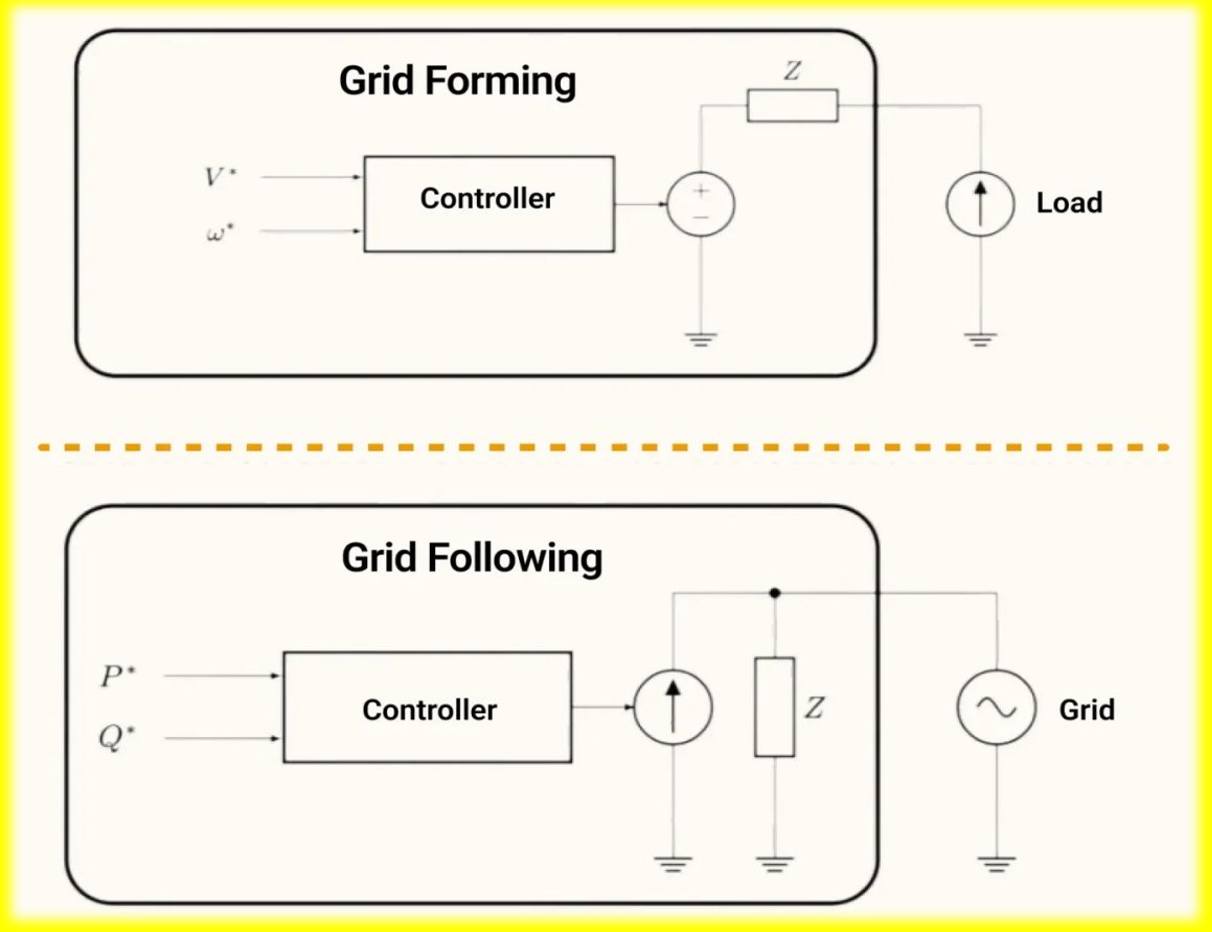
A grid following inverter measures the voltage and frequency of the network it connects to and aligns its own output to match. It acts as a current source, injecting power that rides on top of an already stable waveform. Think of it as a musician playing along to a metronome remove the metronome, and the inverter has nothing to lock onto.

Standard string inverters, most hybrid inverters when grid connected, and the majority of commercial rooftop systems operate this way. The inverter samples the grid every few milliseconds, extracts phase angle and frequency, and adjusts its internal switching to synchronise. When the grid is healthy, this approach is simple, cost effective, and compliant with anti islanding requirements in IEC 62116, IEEE 1547, and UL 1741.
The limitation becomes obvious during an outage. Without a stable voltage and frequency reference, the inverter cannot determine where to place its waveform. It detects the loss, shuts down within two seconds, and waits for the grid to return. This is intentional distribution engineers need assurance that rooftop inverters will not backfeed a line crew working on a supposedly dead feeder.
Practical Consequence for C&I Systems
If your entire array consists of grid following inverters and the utility supply drops, solar generation stops immediately, regardless of battery state of charge. You have hardware worth hundreds of thousands sitting idle until the external grid reappears. For critical loads, this is unacceptable.
Grid Forming Inverters: Creating the Voltage and Frequency Reference
A grid forming inverter does not wait for a reference it generates one. It behaves as a voltage source, establishing the sinusoidal waveform that other devices can synchronise to. This is the same role a traditional diesel generator plays when starting a microgrid from zero, except a grid forming inverter does it electronically, with faster response and no inertia.
Higher specification hybrid inverters, battery energy storage systems with dedicated microgrid modes, and systems integrated with controllers like DEIF, ComAp, Meteocontrol, or Encombi often include grid forming capability. The inverter maintains voltage magnitude and frequency setpoint independently, allowing it to black start a dead bus, supply critical loads, and permit other grid following sources including PV strings and additional battery units to synchronise and share the load.
Configuration in Multi Source Microgrids
When you combine genset, PV, and BESS, the controller must assign one device as the grid former. Typically, the genset runs in isochronous governor mode or the BESS operates in V/f control. The remaining sources switch to grid following mode (droop control for gensets, P/Q mode for inverters). This hierarchy appears in your controller configuration files as master/slave assignments, and getting it wrong leads to hunting, voltage instability, or outright protection trips.
In a system I commissioned last year, the initial programming assigned both the genset and the BESS as grid formers simultaneously. During the first black start test, both tried to impose their own frequency reference, the phase angle drifted by several degrees within ten seconds, and the differential relay opened the tie breaker. Reassigning the BESS to grid following mode and leaving the genset as master resolved it within minutes.
Grid Forming vs Grid Following: Technical Comparison
| Aspect | Grid Following | Grid Forming |
|---|---|---|
| Control mode | Current source, P/Q control | Voltage source, V/f control |
| Reference signal | Requires external grid or forming source | Creates own voltage and frequency reference |
| Black start capability | No | Yes |
| Anti islanding compliance | Mandatory, shuts down when grid lost | Intentionally islands when configured |
| Typical applications | Grid tied PV, most hybrid inverters (grid mode) | Microgrid BESS, hybrid inverters (off grid mode), gensets |
| Fault current contribution | Limited, typically 1.1–1.3× rated current | Can provide higher fault current, depends on design |
| Complexity | Lower, simpler control algorithms | Higher, requires sophisticated voltage regulation |
When Grid Forming Capability Matters
Not every project needs a grid forming inverter. A standard rooftop array feeding a stable utility connection works perfectly with grid following devices. The requirement emerges when any of the following apply:
- The facility demands uninterrupted operation during utility outages
- The system includes a genset and BESS expected to share load in island mode
- You are designing a true microgrid with the ability to disconnect from and reconnect to the main grid
- The application involves weak or unstable grid conditions where the inverter must stabilise voltage rather than merely follow it
- Black start capability is specified in the functional design
In these scenarios, at least one device in the system must operate as a grid former. Whether that role falls to the BESS inverter, a genset, or a dedicated microgrid controller depends on cost, control strategy, and which piece of equipment offers the fastest, most reliable voltage establishment.

Specifying the Right Inverter Mode for Your Project
When reviewing datasheets, look beyond the marketing term “hybrid.” Confirm whether the inverter supports both grid following and grid forming modes, and under what conditions it switches between them. Some units offer grid forming only when grid voltage is absent and battery SOC exceeds a threshold. Others require manual configuration changes or firmware updates to enable the mode.
For systems integrated with third party controllers, verify that the controller can command mode transitions via Modbus, CAN, or hardwired signals. A DEIF controller programmed to black start the BESS will fail if the inverter remains locked in grid following mode waiting for an external reference that never arrives.
Check the inverter’s short circuit contribution in grid forming mode. Protective device coordination your relays, fuses, and breakers assumes a certain fault current magnitude. An inverter that contributes only 1.2 times its rated current may not trip an upstream breaker quickly enough, leaving downstream equipment exposed.
Finally, understand the transition behaviour. When the utility returns and the system must resynchronise, the inverter needs to match voltage magnitude, frequency, and phase angle within the tolerances specified in IEEE 1547.4 or your local grid code before closing the tie. Some inverters handle this automatically in seconds; others require external synch check relays and manual intervention.
Choosing between grid following and grid forming is not an either/or decision. For most projects it is about assigning the correct role to each device, ensuring the controller enforces that hierarchy, and testing the transitions until they work reliably under load. Get the fundamentals right, and the system will start when you need it to and stay stable when others would trip.
Source
The Next-Gen C&I ESS, Liquid-Cooled To Power Tomorrow’s Growth | Sungrow

Related Posts
7 Solar + Battery Design Mistakes I Keep Seeing (Design Review #1)

LiFePO4 Vs Li-ion For Solar Batteries: Which Chemistry Is Better?
