

Medium voltage export limitation in commercial solar installations requires precise metering and control integration to prevent reverse power flow beyond designated boundaries. When a facility operates a private MV ring with multiple step down transformers and wants to add solar PV on one transformer while restricting export past the main incomer, the technical solution involves coordinating advanced metering devices like the Janitza UMG 604 with inverter communication systems such as the Sungrow COM100E or Huawei Smartlogger 3000B. This configuration is particularly relevant for industrial facilities across Africa and other regions where grid operators enforce strict export limitations or where avoiding demand charges requires careful power flow management.
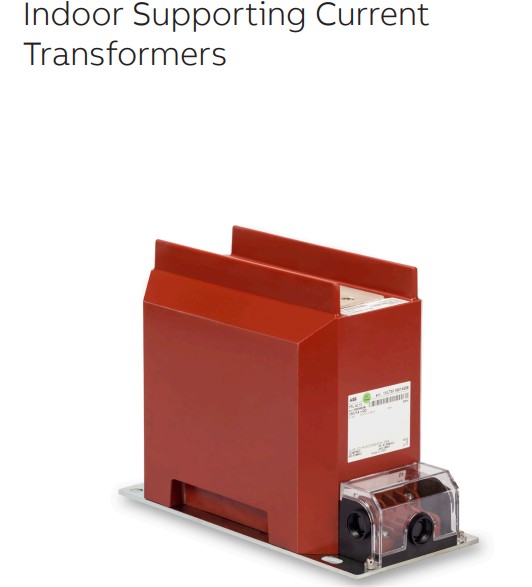
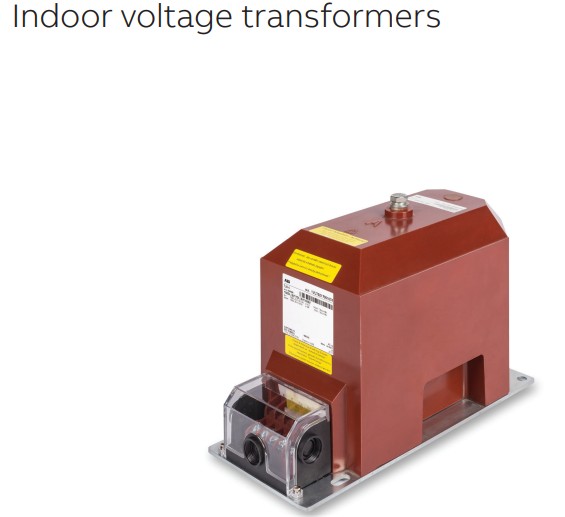
Understanding MV Export Limitation Requirements
Export limitation at medium voltage levels differs fundamentally from low voltage implementations due to the higher power levels involved, typically ranging from 11kV to 33kV depending on regional standards. According to IEC 61000-3-3 and IEC 61000-3-5, installations must prevent voltage fluctuations and harmonic distortion that could affect the wider distribution network. When a facility has an MV incomer feeding a private ring main with multiple transformers, the objective is to allow solar generation to offset loads within the facility while preventing any export past the point of common coupling with the utility grid.
The Janitza UMG 604 serves as a Class 0.5S revenue grade power analyzer compliant with IEC 61557-12, capable of measuring voltage, current, power factor, harmonics and energy with high accuracy. The device accepts current transformer (CT) inputs up to 5A secondary or direct inputs up to 10A, along with voltage transformer (VT) inputs suitable for MV applications. When configured for export limitation, the UMG 604 continuously monitors power flow direction at the main incomer and communicates setpoint adjustments to the solar inverter system.
Inverter Logger Integration and Control Logic
The Sungrow COM100E and the Huawei Smartlogger 3000B serve as a central energy management gateway supporting communication protocols including Modbus RTU, Modbus TCP, and SunSpec Modbus according to IEEE 1547-2018 requirements for smart inverter functions. The loggers receives real time power flow data from the Janitza UMG 604 and translates this into active power curtailment commands for the connected solar inverters. Response times for this control loop typically range from ms to 5 seconds depending on communication settings and inverter specifications.
The control logic operates with configurable threshold settings. For zero export scenarios, the setpoint might be configured with a small offset, such as -5kW, to account for measurement tolerances and communication delays while preventing actual export. When the Janitza UMG 604 detects power flow approaching this threshold meaning facility load is satisfied and excess generation risks flowing back to the grid it signals the logger to reduce inverter output proportionally. The logger then issues power reduction commands via Modbus register writes to the inverter’s active power setpoint.
Practical Implementation for Multi Transformer Ring Configurations
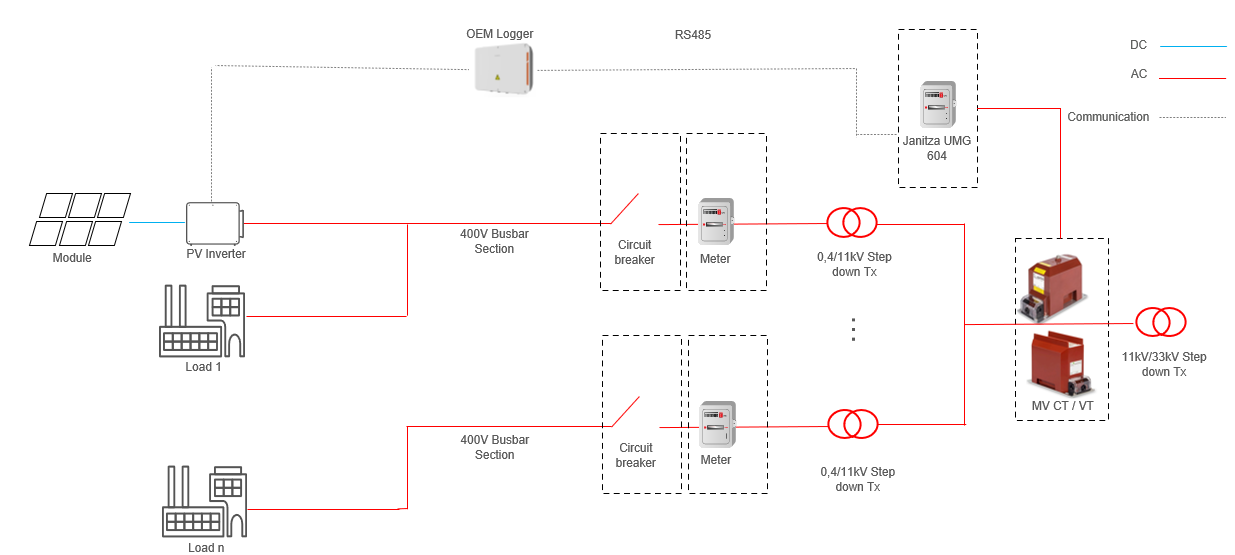
In a facility with three step down transformers on an internal MV ring, the measurement point placement becomes critical for effective export limitation. The configuration described involves solar PV connected to one transformer while power must be permitted to flow to the other two transformers but blocked at the main incomer. This requires installing the CT and VT instrumentation specifically at the main incomer location, not at individual transformer positions.
| Component | Location | Function |
|---|---|---|
| Main CTs and VTs | MV incomer switchgear | Measure total facility import/export |
| Janitza UMG 604 | Main switchboard panel | Process measurements, execute control logic |
| Inverter Logger | PV plant control room | Translate setpoints to inverter commands |
| Solar inverters | Transformer with PV connection | Execute curtailment commands |
The internal ring configuration allows generated solar power to distribute naturally across all three transformers based on load demand. When combined load across all transformers exceeds solar generation, the facility imports the difference through the main incomer. When solar generation exceeds total facility load, the export limitation system activates to curtail generation before reverse flow occurs at the incomer. This approach complies with G99 requirements in regions following UK standards, IEEE 1547 in North American or NRS 097 in South Africa contexts, both of which mandate controlled response to abnormal grid conditions.
Communication Wiring and Protocol Configuration
The communication link between the Janitza UMG 604 and loggers typically utilizes Modbus RTU over RS485 for reliability in industrial environments with electrical noise. The wiring requires twisted pair cable with characteristic impedance of 120Ω, commonly specified as Belden 3105A or equivalent. Maximum cable length should not exceed 1200 meters without repeaters, though practical installations rarely approach this limit. Both ends of the RS485 bus require 120Ω termination resistors to prevent signal reflections that could corrupt data transmission.
Installing MV export limitation systems with the Janitza UMG 604 and Sungrow COM100E or Huawei Smartlogger 3000B provides facilities with precise control over power flow boundaries while maximizing solar self-consumption. The key to successful implementation lies in correct CT/VT placement at the main incomer, proper polarity connections, and reliable Modbus communication with appropriate response timing. For installations across Africa and globally, this approach enables compliance with grid codes while delivering optimal economic performance from commercial solar investments.
Sources
10kV & 35kV Switchgear CT PT Selection: A Practical Replacement Guide

Related Posts

What Is The Difference Between Grid Following Vs Grid Forming

Grid tied Solar System Explained: What SA Homeowners Need to know
